Why Your Vinyl Sounds Distorted: Pressing Issues Explained
There’s nothing quite like dropping the needle on a freshly pressed record — that warm, rich sound filling the room. But what happens when instead of music, you’re greeted with crackling, muddiness, or outright distortion? It’s frustrating, especially when you’ve invested time and money into a vinyl project.
If you’ve been wondering why your vinyl sounds distorted, you’re not alone. Distortion on vinyl records is more common than most people realise, and more often than not, it traces back to vinyl record pressing issues during the production process itself. Understanding what causes distortion can save you a lot of headaches and help you make smarter choices when pressing your next record.
What Does Vinyl Record Distortion Sound Like
Before diving into causes, it helps to know what you’re listening for. A distorted vinyl record might produce:
- A harsh, fuzzy sound on loud or high-frequency passages
- Sibilance (an exaggerated “ssss” sound on vocals)
- Dull or muffled audio that lacks clarity
- Crackling or popping unrelated to dust or scratches
- Audio that sounds “pinched” or compressed in the inner grooves
These are all signs that something went wrong — either during mastering, the cutting stage, or the press itself.
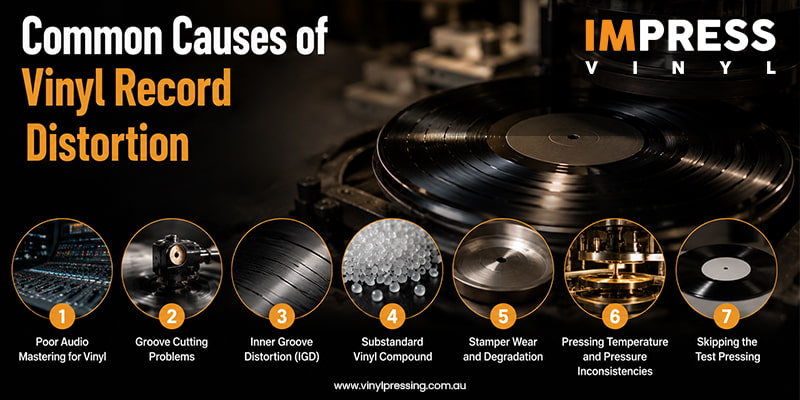
Common Causes of Vinyl Record Distortion
-
Poor Audio Mastering for Vinyl
One of the most overlooked causes of vinyl distortion actually starts before pressing begins. Vinyl is a physical medium with real limitations. It cannot handle the same frequencies or dynamic range as a digital file.
If audio isn’t properly mastered for vinyl, the cutting lathe struggles to translate the signal into grooves accurately. Excessive bass, over-compressed audio, or too-wide stereo imaging can all result in a distorted vinyl record before a single copy is pressed.
This is why working with an experienced mastering engineer who understands the unique requirements of vinyl is essential.
-
Groove Cutting Problems
The lacquer cutting stage is where your audio is physically translated into grooves on a disc, and precision at this point is critical. If the cutting stylus is worn, misaligned, or operating at incorrect settings, the groove geometry suffers — and so does playback quality.
Grooves cut too deep risk overlapping with adjacent grooves. Grooves cut too shallow make it difficult for the stylus to track accurately during playback, resulting in thin, distorted, or erratic sound. The cutting stage is one of the most technically demanding parts of the entire vinyl production process, and errors here carry through to every copy pressed.
-
Inner Groove Distortion (IGD)
This is one of the most well-known vinyl pressing defects. As the needle moves toward the centre of a record, the groove velocity decreases. This makes it physically harder for the stylus to track high-frequency or loud passages accurately.
The result? Distortion that seems to worsen as a song plays out — particularly noticeable on tracks placed near the end of a side. Careful sequencing and level management during mastering can reduce inner groove distortion significantly, but it requires expertise to get right.
-
Substandard Vinyl Compound
Not all vinyl is created equal. Lower-grade PVC compounds produce noisier pressings — you’ll hear it as a higher surface noise floor and increased distortion during playback, particularly on quieter passages.
Quality pressings use premium-grade PVC that allows grooves to be formed cleanly and consistently. The difference is audible, especially to experienced listeners. Cutting costs on materials at this stage is a false economy — the saving rarely justifies the drop in sound quality.
-
Stamper Wear and Degradation
Stampers are the metal molds used to press records, and like any tooling under repeated stress, they wear over time. As a stamper degrades, the fine groove detail it can reproduce diminishes — resulting in progressively noisier, less detailed pressings as a run continues.
A quality pressing plant monitors stamper condition carefully and retires them before degradation becomes audible. Plants that don’t can unknowingly ship later copies from the same run that sound noticeably worse than the first.
records are made at a place that does not check the stampers very often. Stampers are a part of making records and when they wear out the records do not sound as good as they should.
-
Pressing Temperature and Pressure Inconsistencies
The actual pressing stage involves applying heat and pressure to a vinyl puck sandwiched between two stampers. If the temperature is too high, too low, or inconsistent across the press cycle, the groove detail suffers. This can cause playback issues that range from mild cloudiness to outright distortion on louder passages.
Consistent, controlled pressing conditions are a hallmark of a quality pressing plant and a major reason why choosing the right manufacturer matters.
-
Skipping the Test Pressing
One of the most common mistakes, especially for first-time vinyl projects is skipping the vinyl test pressing stage. A test press is your chance to hear exactly what the final product will sound like before the full run is committed.
Without it, any of the causes of vinyl record distortion mentioned above can go undetected until you’re holding 300 copies of a record that doesn’t sound right. It’s a small upfront cost that can save an entire project.
How to Avoid Pressing Quality Problems
The best way to avoid a distorted vinyl record is to work with a pressing partner who understands the craft from end to end. That means proper audio mastering for vinyl, quality cutting, premium materials, and rigorous quality control throughout the process.
That’s what we do at Impress Vinyl. With over 20 years of experience pressing records for bands, independent artists, and labels across Australia, we handle everything from lacquer cutting and metal work through to the final press and packaging. Every step is managed carefully, so what ends up on your record actually sounds the way it should.
Whether you’re pressing 100 copies or 1,000, get a quote on our pricing page or get in touch with our team — we’ll guide you through the process and help you avoid the pitfalls that lead to sound quality problems.
Final Thoughts
Vinyl distortion isn’t something you just have to accept. In most cases, it’s a sign of underlying vinyl record pressing issues. These can include the mastering, the cutting, the materials, or the press itself. Knowing what to look and listen for puts you in a much stronger position to get a result you’re genuinely proud of.
If you’re planning a vinyl pressing project and want to get it right the first time, get in touch with Impress Vinyl or check out their pricing page to get started.