Vinyl Pressing vs CD Manufacturing: Which Is Right for Your Music Release
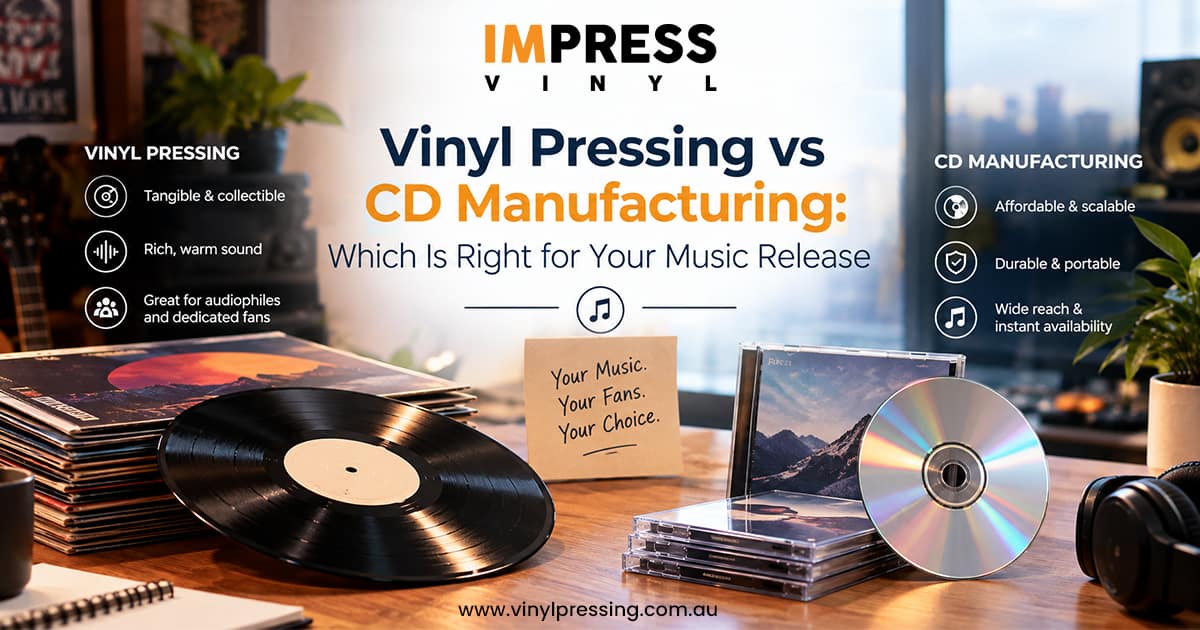
Finished the album? Good. Mastering’s done, artwork’s approved, and now somebody at band practice asks the awkward question: are we pressing vinyl, making CDs, or splitting the budget?
We hear this from bands and labels all the time, and the honest answer is that it depends. On your fans, mostly. On your budget, a bit more than you’d like. So let’s go through it.
Vinyl vs CD: What’s the Real Difference?
Vinyl is analogue. Your music gets physically cut into a groove, and the person who buys it usually wants something to hold, flip over and put on a shelf. A CD is a digital disc, cheaper per copy and much quicker to produce. Both still sell. They just sell to different people.
Most vinyl vs CD arguments turn into arguments about sound, but in practice the choice comes down to cost, timing and what your fans expect to find at your merch table.
Vinyl Records vs CDs: How Each One Is Made
Making a record is slow and a bit old school. Your master goes to a lacquer cut, the lacquer gets plated into metal stampers, and those stampers press hot PVC into the finished record. Plenty can go wrong between those steps, which is why a test pressing is worth the wait.
CD manufacturing is a different animal. Your audio is written to a glass master, which is then used to stamp polycarbonate discs that get a reflective coating and a protective layer. That’s CD replication. Don’t confuse it with duplication, where discs are simply burned one by one. Replication makes sense once you’re ordering in the hundreds; duplication is fine for a handful of demos.
Vinyl vs CD Sound Quality: Does It Matter
On paper, the CD wins. It has a lower noise floor, no surface crackle and plays back the same every time (16-bit/44.1kHz, if you like numbers).
Vinyl does something else. It’s warmer, a touch softer up top, and yes, it crackles now and then. Long sides also squeeze the groove, so you lose some volume and low-end punch. Plenty of listeners love that. Others can’t stand it.
So on vinyl vs CD sound quality, nobody gets a clean win. It tastes good. What isn’t a matter of taste is mastering: a file prepared for CD shouldn’t just be handed over for vinyl. Ask for a vinyl master.
Vinyl Pressing Cost vs CD Manufacturing
Here the two formats split.
Vinyl pressing cost per record is higher. You’re paying for plating, PVC, slower machinery and a jacket on top, and minimum runs usually start at a few hundred copies. CD manufacturing costs less per disc, and the gap widens as quantities grow.
Still, selling price matters. A record usually retails for much more than a CD, so the profit on each copy can end up healthier even though the upfront bill is bigger. The final number depends on how many you order, whether you want coloured vinyl, record weight, the sleeve style and whether you add a test pressing. Get itemised quotes so you’re comparing the same things.
Vinyl Pressing in Australia: Why Going Local Helps
If you’re an Australian act, vinyl pressing in Australia saves you real headaches. No overseas freight sitting in a port, no customs paperwork, and no waiting overnight for someone in another time zone to answer an email about your artwork. You deal with a person who understands your release, and the records arrive closer to the fans who ordered them.
One warning: vinyl takes time wherever you press it. Book early and build your release date around the pressing schedule, not the other way round.
So, Which Format Should You Choose?
Go with vinyl if your audience collects records or you want a keepsake that makes the release feel like an event. Go with CDs if you’re selling at gigs, sending music to press or radio, or reaching people who don’t own a turntable. If the budget stretches, do both: a small vinyl run for the superfans and CDs for everyone else.
Why Impress Vinyl Is the Right Choice for Your Next Music Release
If vinyl is on your shortlist, Impress Vinyl is the right choice for your next music release. We provide quality vinyl record pressing in Australia from our Melbourne base, and we’ve spent more than 20 years working with bands and labels. Custom vinyl record packaging, test pressings and straight advice on whether vinyl, CDs or both suit your project are all part of the job.